The Psychology of Mirror Neurons, Mimicry, and Identity Confusion
The Mirror Brain
Why we copy others — and don’t even know we’re doing it
You’re at a coffee shop, deep in conversation with a friend. Without realizing it, you lean forward when they lean forward. You cross your legs when they cross theirs. Your voice softens to match their tone. You’re not consciously trying to mimic them—it’s happening automatically, beneath the surface of your awareness.

This isn’t coincidence. It’s your mirror brain at work.
Hidden within your skull is a network of neurons that fire not just when you act, but when you watch someone else act. They’re quietly choreographing a dance of imitation that shapes who you are, how you connect, and even how you see yourself. Yet most of us have no idea this neural puppetry is happening.
Welcome to the strange, beautiful, and sometimes unsettling world of human mimicry—where the line between “you” and “them” is far blurrier than you think.
The Neurons That Changed Everything

In the 1990s, researchers studying macaque monkeys made an accidental discovery that would revolutionize our understanding of the brain. They were monitoring neurons that fired when a monkey reached for a peanut. But something unexpected happened: the same neurons fired when the monkey simply watched another monkey reach for a peanut.
These “mirror neurons” seemed to create an internal simulation of observed actions. When you watch someone smile, throw a ball, or wince in pain, specific neurons in your brain fire as if you were performing those actions yourself. Your brain doesn’t just see—it experiences.
But here’s where it gets fascinating: mirror neurons don’t just copy what they see. They’re trying to understand why someone is acting. When you watch a friend reach for their coffee cup, your mirror neurons are silently asking, “Are they going to drink it? Move it? Share it?” This internal simulation helps you predict their next move and understand their intentions.
It’s as if your brain contains a tiny theater where every human interaction you witness gets performed on your own neural stage. You’re not just an observer of other people’s lives—you’re unconsciously rehearsing them.
The Chameleon Effect: When Copying Becomes Connection

Sarah notices she’s picked up her coworker’s habit of saying “fair enough” in meetings. Marcus realizes he’s unconsciously adopted his girlfriend’s laugh. Emma finds herself using the same hand gestures as her favorite podcast host.
This is the “chameleon effect”—our tendency to unconsciously mimic the postures, mannerisms, speech patterns, and expressions of the people around us. It’s so automatic that we rarely notice it happening, yet research shows it’s one of the most powerful forces shaping our social connections.
When you mirror someone, magical things happen. They like you more. They trust you more. They feel more connected to you. Waitresses who verbally mimic their customers’ orders receive higher tips. People who are mimicked become more helpful—not just to the person who copied them, but to complete strangers. It’s as if being mirrored creates a ripple effect of goodwill that extends far beyond the original interaction.
From an evolutionary perspective, this makes perfect sense. Our ancestors who could read social cues, build alliances, and maintain group harmony were more likely to survive. Those who stood apart or couldn’t connect were more vulnerable to the dangers of isolation. Mimicry became our species’ social glue—an unconscious way of saying, “I’m like you. I belong here. We’re safe together.”
But this ancient wiring creates some strange experiences in our modern world.
The Identity Puzzle: When You Feel Like Everyone Else

“I don’t think I have my own personality,” confesses a user on Reddit. “I just become whoever I’m talking to. It’s like I’m a chameleon, but instead of colors, I’m changing everything about myself.”
The responses flood in: “I do this too.” “I thought I was the only one.” “Sometimes I don’t know who I really am.”
This feeling—of being a social shapeshifter without a core identity—is more common than you might think. For some, it’s a mild quirk. For others, it’s distressing. They report feeling like they’re performing different versions of themselves depending on who they’re with, leaving them wondering: Which one is real?
The answer isn’t simple. Research suggests that personality is more fluid than we often assume. We do naturally adapt our behavior to different social contexts—it’s a survival skill that helped our ancestors navigate complex tribal relationships. The person you are with your grandmother is different from who you are with your college friends, and that’s not fake—it’s human.
But when this adaptive behavior goes too far, it can create what psychologists call “identity diffusion.” Some individuals become so skilled at reading and reflecting others that they lose touch with their own preferences, values, and authentic responses. They might excel at making others comfortable but feel empty or anxious when alone.
This is particularly common during adolescence, when identity is still forming and peer influence is at its peak. Teenagers naturally experiment with different personas, trying to figure out what fits. But if this “psychological moratorium” extends too long into adulthood, it can leave someone feeling like they never quite figured out who they are underneath all the mimicry.
The Dark Side of the Mirror

Mirror neurons and mimicry aren’t always benevolent. They can make us vulnerable in ways we don’t expect.
Manipulative individuals—narcissists, psychopaths, skilled con artists—often exploit our tendency to mirror and be influenced by those who mirror us. They become masters of artificial rapport, using our own neural wiring against us. People-pleasers, who are naturally high in mimicry, can find themselves particularly susceptible to these dynamics.
There’s also the exhaustion factor. Constantly adapting to others’ energy and expectations—what some call “masking” or consciously hiding one’s true traits to fit social norms—can be emotionally draining. This is particularly true for neurodivergent individuals who may feel pressure to mirror neurotypical behaviors to fit in, leading to burnout and a sense of living an inauthentic life.
And then there’s the cultural dimension. In our globalized world, we’re exposed to more diverse ways of being than ever before. Social media gives us endless models to mimic—speech patterns, values, even entire lifestyles from people we’ve never met. The question becomes: Which influences are serving us, and which are leading us away from ourselves?
The Accent of Belonging
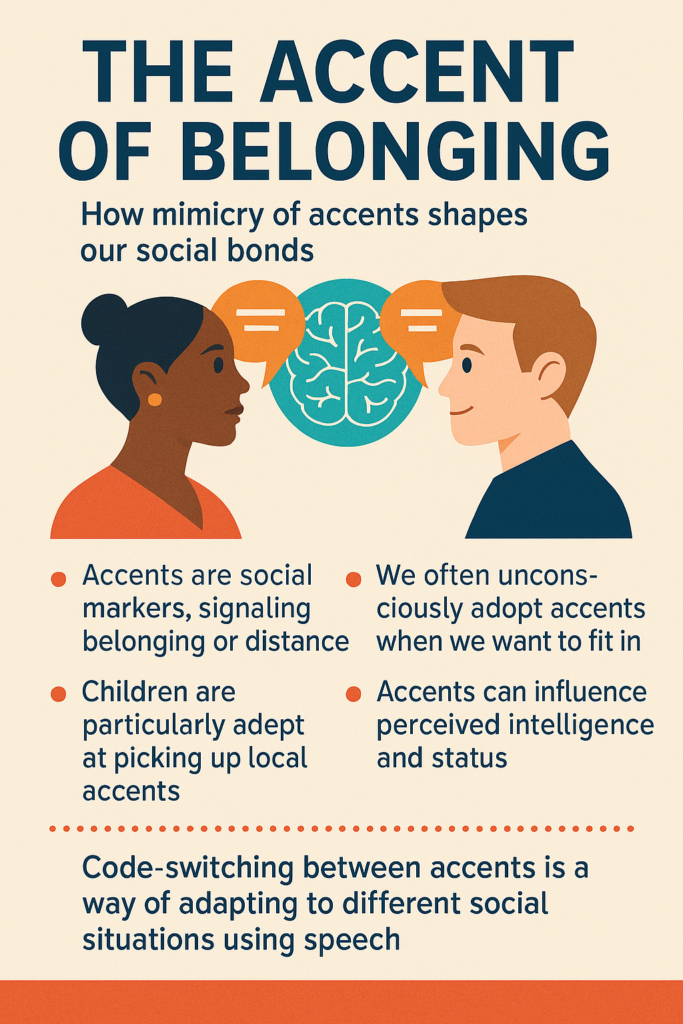
Language offers perhaps the most noticeable example of mimicry in action. Accents aren’t just about geography—they’re social markers that signal belonging or distance from particular groups.
You’ve probably experienced this yourself: spending time with someone who has a different accent and finding their speech patterns creeping into your own. Maybe you unconsciously adopted a slight Southern drawl after visiting relatives in Georgia, or found yourself using British phrases after binge-watching BBC shows.
This isn’t mockery—it’s your brain’s automatic attempt to create social connection through linguistic synchrony. Children are particularly adept at this, which is why kids who move to new regions often pick up local accents faster than their parents.
But accents carry social weight. Research shows that certain accents are perceived as more prestigious, intelligent, or trustworthy, while others face discrimination. Your brain’s innocent attempt to fit in through accent mimicry might actually be navigating complex social hierarchies you’re not even aware of.
The teenager who “code-switches” between different speech patterns when talking to family versus friends isn’t being fake—they’re demonstrating sophisticated social intelligence, adapting their communication style to maintain connection across different cultural contexts.
When Mimicry Becomes Healing
Understanding mirror neurons has opened up surprising therapeutic possibilities. Therapists working with children on the autism spectrum use mirror neuron activation therapy to help improve social interaction and emotional understanding. Music therapy leverages our natural tendency to synchronize and mirror musical patterns to promote healing and connection.
For individuals recovering from strokes or motor disabilities, observing others perform actions can actually help retrain their own motor systems. The brain’s ability to learn through mirroring becomes a pathway to recovery.

Even in mental health treatment, therapists unconsciously use mimicry to build rapport with clients—subtly matching their posture, tone, or energy level to create a sense of safety and understanding. The therapeutic relationship itself often relies on this delicate dance of mirroring and authenticity.
Finding Yourself in the Hall of Mirrors
So what do you do if you’re someone who feels lost in the endless reflections of other people’s personalities? How do you find your authentic self when you’re naturally wired to adapt to others?
The key isn’t to stop mirroring—that would be like trying to stop breathing. Instead, it’s about developing what researchers call “mindful mimicry.” This means becoming aware of when and why you’re adapting, and making conscious choices about which adaptations serve you and your relationships.

Start by spending time alone. Not scrolling through social media or consuming other people’s content, but actually being with yourself. Notice what you’re drawn to when no one else is around. What makes you laugh when you’re by yourself? What are you curious about? What feels peaceful or energizing to you personally?
Keep a journal of your genuine reactions before you’ve had time to calibrate them to others’ expectations. Notice the moments when you feel most like “yourself”—what’s happening in those situations? Who are you with? What are you doing?
Pay attention to your values—the principles that remain consistent regardless of who you’re around. Even the most adaptive person has core beliefs and moral boundaries that don’t shift with social context. These can serve as anchor points for your identity.
And remember: the ability to mirror and adapt is actually a strength. It makes you an excellent communicator, a skilled teammate, and a empathetic friend. The goal isn’t to become rigid, but to ensure that beneath all the social adaptation, there’s a solid sense of who you are when the performance ends.
The Neural Symphony of Connection
Your mirror brain is conducting an invisible symphony every time you interact with another human being. It’s helping you understand intentions, build bonds, learn new skills, and navigate the complex social world you inherited from your ancestors.
This neural mirroring is so fundamental to human experience that it shapes everything from how you fall in love (couples in healthy relationships unconsciously synchronize their movements and even their heart rates) to how you parent (babies learn to smile by watching and mirroring their caregivers’ expressions).

It’s why you yawn when others yawn, why you feel phantom pain when watching someone get hurt, and why certain people just feel “easy” to be around—your nervous systems are literally in sync.
But perhaps most importantly, understanding your mirror brain can help you be more intentional about the influences you expose yourself to. If you’re going to unconsciously absorb aspects of the people around you, it’s worth choosing those people carefully.
The Performance That Never Ends
🧠 Key Takeaways from The Mirror Brain
- Mirror neurons help us unconsciously simulate others’ actions and emotions
- Mimicry strengthens social connection—but can blur our sense of self
- Identity fluidity is normal, but too much adaptation can lead to confusion or burnout
- Awareness of who you mirror can help you choose more authentic influences
We are all performers on each other’s stages, and we are all audiences for each other’s performances. The line between authentic self-expression and social adaptation isn’t as clear as we’d like to believe. Maybe that’s not a problem to solve, but simply the reality of being human in relationship with other humans.
Your mirror neuron system will keep firing whether you’re aware of it or not. The question isn’t whether you’ll be influenced by others—you will. The question is whether you’ll be conscious enough to choose which influences you want to amplify and which ones you want to resist.
In a world that often feels disconnected, perhaps there’s something beautiful about the fact that we’re literally wired to reflect each other. Your brain contains echoes of everyone you’ve ever loved, learned from, or spent time with. You carry pieces of your family, your friends, your teachers, and even strangers you’ve encountered.

You are not just yourself—you are also a walking collection of everyone who has ever mattered to you. And in return, you become part of their internal symphony, a note in the ongoing composition of their identity.
The mirror brain reminds us that the boundaries between self and other are more porous than we imagine. We are separate individuals, yes—but we are also fundamentally interconnected, constantly shaping and being shaped by the social world we inhabit together.
Before you go: Take a moment this week to notice your own chameleon moments. When do you find yourself naturally adapting? With whom do you feel most like “yourself”? There’s no judgment here—just curiosity about the subtle ways you navigate your social world.

Next time, we’ll explore an even stranger aspect of human psychology: why we lie to ourselves—and how self-deception might actually be one of our most sophisticated survival tools. Because sometimes, to keep functioning in an uncertain world, we need to believe things that aren’t quite true…
If You Want to Go Deeper
Books:
- The Tell-Tale Brain by V.S. Ramachandran (explores mirror neurons and their implications for human consciousness)
- Social by Matthew Lieberman (examines our brain’s social networks and why connection matters)
- The Charisma Myth by Olivia Fox Cabane (practical applications of mirroring and rapport-building)
Research Papers:
- “The Chameleon Effect: The Perception-Behavior Link and Social Interaction” by Chartrand & Bargh (the foundational study on unconscious mimicry)
- “Mirror Neurons and Social Cognition” by Iacoboni (comprehensive review of mirror neuron research)
Documentaries:
- The Brain with David Eagleman (PBS series with excellent episodes on social brain networks)
- The Human Brain (BBC documentary exploring neural basis of empathy and connection)
For Self-Discovery:
- Try the Values in Action character strengths survey to identify your core traits
- Explore Internal Family Systems therapy if you struggle with shifting identities
- Practice mindfulness meditation to develop awareness of your automatic social responses