Why our brains give fear the mic — even when there’s no real danger

Picture this: You’re walking through a quiet neighborhood at dusk when you hear footsteps behind you. Instantly, your heart pounds, your muscles tense, and your mind races through worst-case scenarios. But when you turn around, it’s just someone walking their dog. Your brain jumped to “danger” before you could even process what was actually happening.

This isn’t a bug in your system—it’s a feature. Fear doesn’t wait for permission or logic. It barges in like an uninvited guest who thinks they’re saving your life. And in many ways, throughout human history, that uninvited guest has been right.
Fear is our first emotion, the one that gets priority access to the control room of our minds. It’s the ancient software still running in the background of our modern lives, whispering warnings about threats that may not even exist. But to understand why we catastrophize about emails and imagine worst-case scenarios during job interviews, we need to trace fear back to its evolutionary origins—when being afraid meant the difference between dinner and becoming dinner.
Why Your Brain Freaks Out Over Burnt Toast

Your brain operates like an overly sensitive smoke detector. Just as your kitchen alarm goes off for burnt toast as readily as it does for an actual fire, your fear system is calibrated to be hypersensitive. It would rather sound a thousand false alarms than miss one real threat.
Did you know? Your amygdala can respond to a threat in less than 12 milliseconds—faster than conscious awareness.
Think about it from your ancestors’ perspective. If they heard rustling in the bushes, they had two choices: assume it was dangerous and run, or assume it was harmless and stay put. Those who ran away from nothing lived to hear another rustle. Those who stayed put when it was actually a predator… well, they didn’t pass on their genes.
The cost-benefit analysis was simple: being overly cautious cost you some energy, but being under-cautious could cost you everything. So we evolved to be professional pessimists, writing insurance policies for worst-case scenarios.
Ever wonder why your chest tightens when you see “We need to talk” in a text? That’s your ancient alarm system treating a vague message like a saber-toothed tiger sighting.
Caveman Code, Corporate Problems
Here’s where modern life gets tricky. We’re running Stone Age software on twenty-first-century problems. Your amygdala still thinks you’re wandering the savanna, where social rejection meant being left alone to face predators, and every unfamiliar sound could signal mortal danger.
But now? Instead of lions, we have Slack notifications marked “urgent.” Instead of rival tribes, we have performance reviews. Instead of physical predators, we have that coworker who leaves passive-aggressive comments in shared documents.
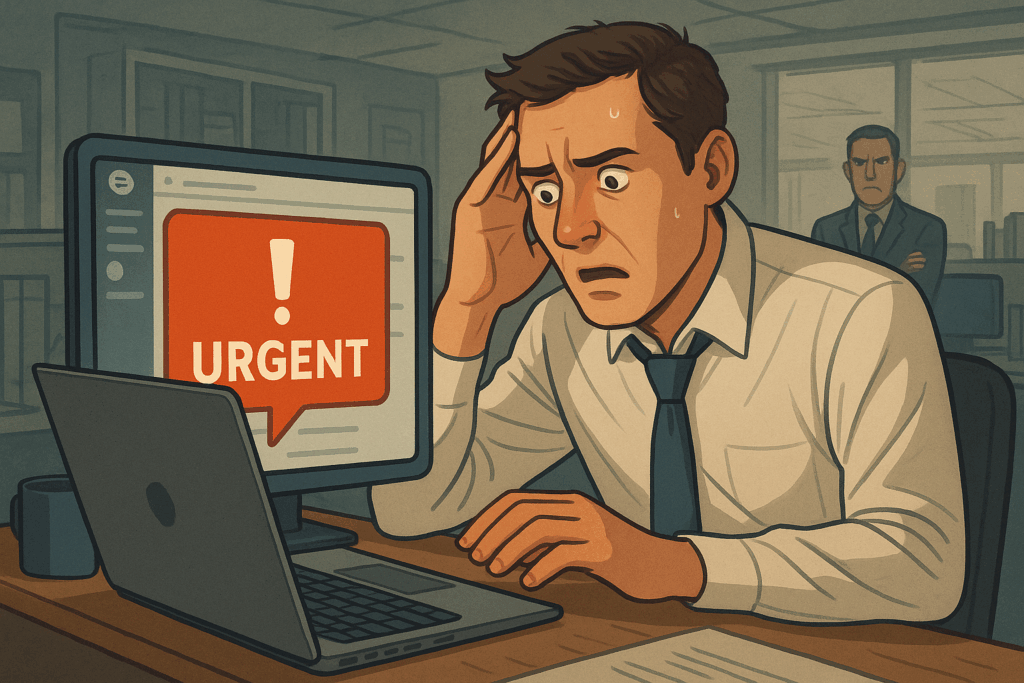
Picture this: You walk into a meeting five minutes late. Everyone looks up. Your brain’s threat detection system kicks in as if you’ve just stumbled into enemy territory. Your heart pounds, your face flushes, your mind immediately scripts a narrative about being fired, losing your apartment, and becoming a cautionary tale.
Pause and ask yourself: what’s your brain interpreting as a “tiger” today?
The Two Highways of Fear
To understand how fear hijacks your thoughts, you need to know about the two different routes it takes through your brain: the express lane and the scenic route.
The Amygdala: Fear’s VIP Express Lane
The amygdala doesn’t believe in taking its time. When sensory information comes in, it takes a shortcut directly from your thalamus to your amygdala, bypassing your rational brain entirely. This is why you can jump at a shadow before you even register what you’re looking at.
Imagine your chest tightening, your vision narrowing, your jaw clenching as you read an email from your boss with the subject line “Quick chat.” That’s your amygdala flooding your system with stress hormones before your thinking brain can even finish reading the message.

When your amygdala takes control, your prefrontal cortex—the part responsible for rational thought—basically gets put on hold. It’s like having a security guard who shoots first and asks questions later. Effective for genuine emergencies, exhausting for everyday life.
This is why you can’t logic your way out of a panic attack in the moment. Your thinking brain has temporarily lost access to the control room.
The Cortex: Your Brain’s Catastrophe Generator
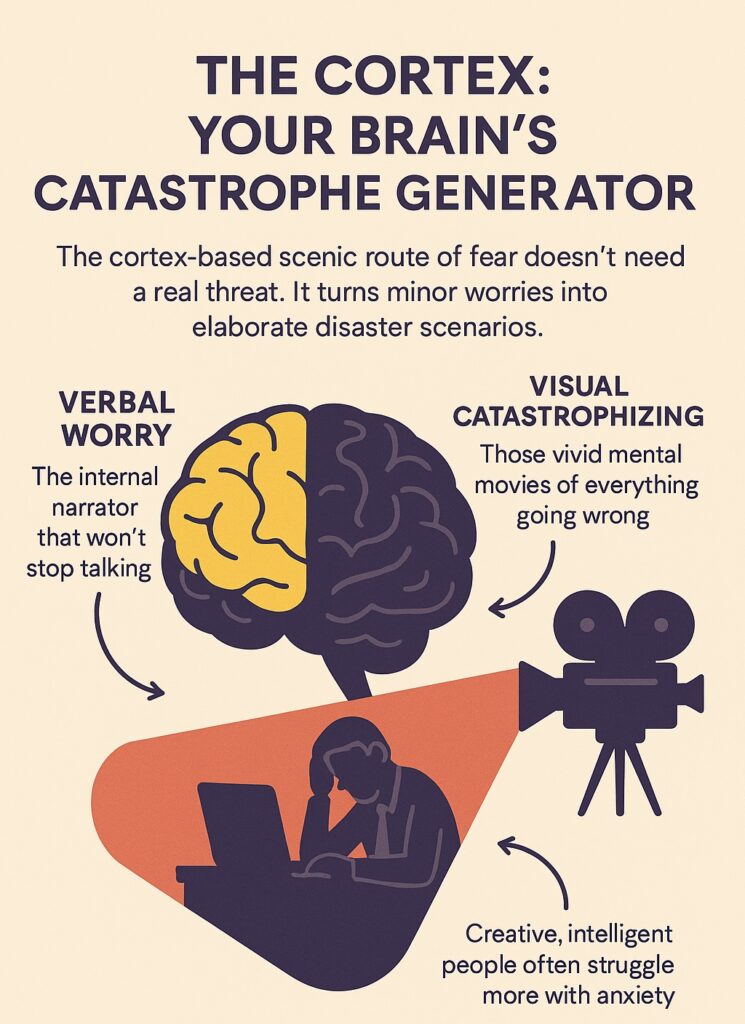
Then there’s the scenic route—cortex-based fear. This doesn’t need any real threat to get started. It’s your imagination’s horror movie theater, where your mind scripts elaborate disaster scenarios before you’ve even gotten out of bed.
Your cortex is incredibly good at its job: predicting and preparing for potential futures. But when anxiety gets involved, it becomes a professional catastrophe writer. It can take a minor worry—like being five minutes late—and transform it into a full disaster film about career destruction.
Ever felt like your brain was rehearsing disaster for no reason? That’s your cortex writing its horror script.
The left hemisphere specializes in verbal worry—that internal narrator that won’t stop talking. The right hemisphere contributes visual catastrophizing—those vivid mental movies of everything going wrong. And here’s the kicker: creative, intelligent people often struggle more with anxiety because the same mental abilities that make you good at innovation also make you exceptionally skilled at imagining elaborate worst-case scenarios.
Your Brain’s Catastrophe Generator in Action
Catastrophizing feels horrible, but it made evolutionary sense. Imagining worst-case scenarios was like having an insurance policy. If you mentally rehearsed what could go wrong, you’d be better prepared if it actually happened.
Your ancestors who spent time thinking “What if the hunt fails?” were more likely to have backup plans. Those who wondered “What if other tribes attack?” were more likely to build defenses. Catastrophic thinking was basically early humans doing risk assessment.
Here’s a modern example: You send a work email and don’t get a response for three hours. Your brain immediately starts writing the story: They hate my idea. I’ve overstepped. I’m going to get fired. I’ll never find another job in this economy. I’ll lose my apartment. My parents will be disappointed. I’ll end up alone and destitute.
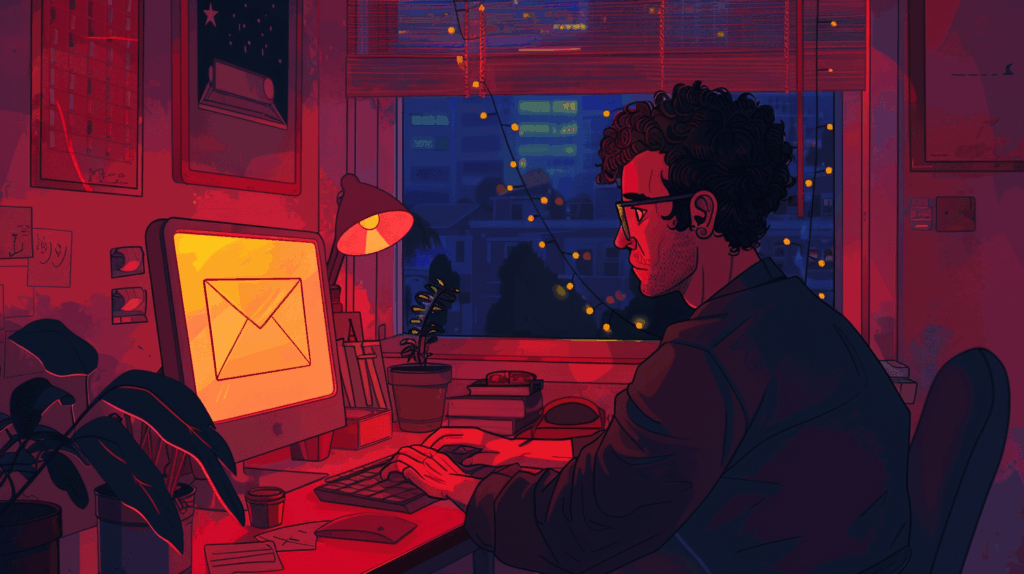
All of this from… a delayed email response. Your ancient insurance policy is still running, but there’s often no clear action to take. The energy that once went into immediate survival responses now gets channeled into worry spirals and 3 AM anxiety sessions.
When Words Become Weapons
Even the words we encounter can trigger fear responses. Certain phrases act like emotional landmines, instantly activating your threat detection system. Words like “emergency,” “urgent,” “failure,” and “we need to talk” can spike your stress levels even when you’re completely safe.

Fascinating fact: This effect is stronger in your native language. Speaking or hearing fears described in a foreign language creates psychological distance, reducing the emotional impact.
Your fear system doesn’t distinguish between reading about danger and experiencing it directly. This is why scrolling through news can leave you feeling anxious even when none of the events directly affect your life, or why your heart rate can spike from reading work emails after hours.
Social Fear: When Belonging Feels Like Life or Death
Physical threats weren’t the only dangers our ancestors faced. Social rejection could be just as deadly. Being cast out from your tribe meant facing the wilderness alone—a virtual death sentence.
This is why your body responds to public embarrassment the same way it responds to physical danger. Your brain treats a presentation going badly or saying something awkward at a party as serious threats to your survival.
Here’s something wild: In one study, socially anxious people responded to neutral faces as if they were threatening.
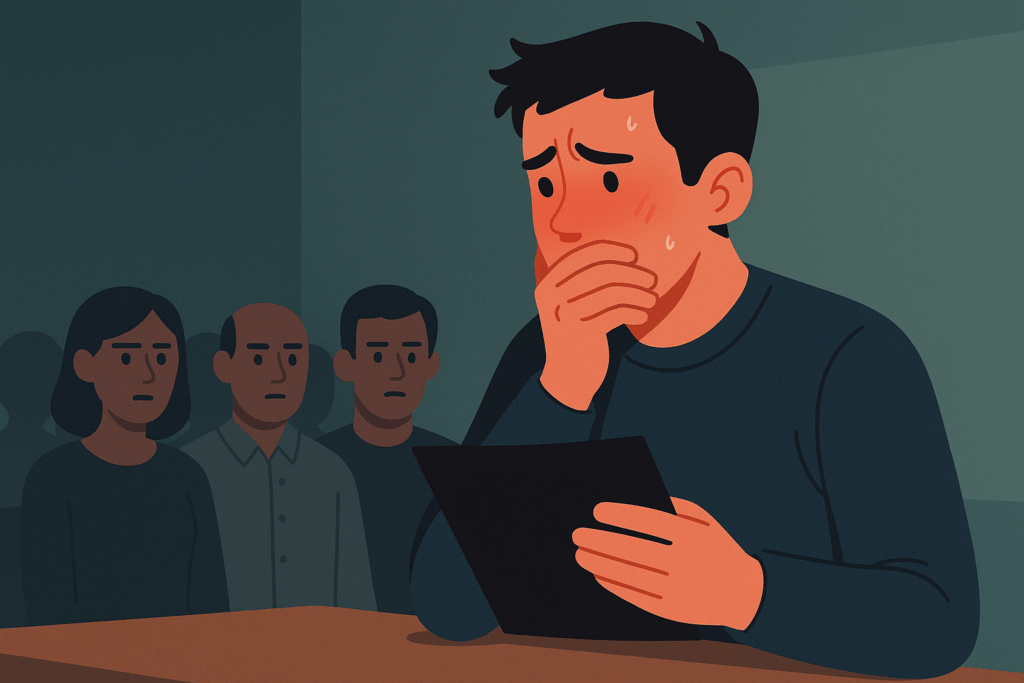
Social fears create their own vicious cycle. You worry about others noticing your anxiety symptoms—the sweating, blushing, or voice trembling—which makes you more anxious, which makes the symptoms more noticeable. It’s like being afraid of being afraid, with your body becoming both the source and the evidence of your fear.
Think about the last time you had to speak up in a meeting. Maybe your voice shook slightly, or you felt your face get warm. Suddenly you’re not thinking about your actual point anymore—you’re thinking about whether everyone noticed your nervousness, which makes you more nervous, which makes you more noticeable.
So… Can We Ever Actually Chill?
Understanding that fear is your first emotion doesn’t make it disappear, but it does change how you relate to it. More importantly, once you know how your ancient alarm system works, you can learn to work with it instead of against it.
Your fear system isn’t broken—it’s just overqualified for modern life. The goal isn’t to disable your inner smoke detector, but to become a better interpreter of its signals. Here’s how:
When Your Amygdala Hijacks the Moment
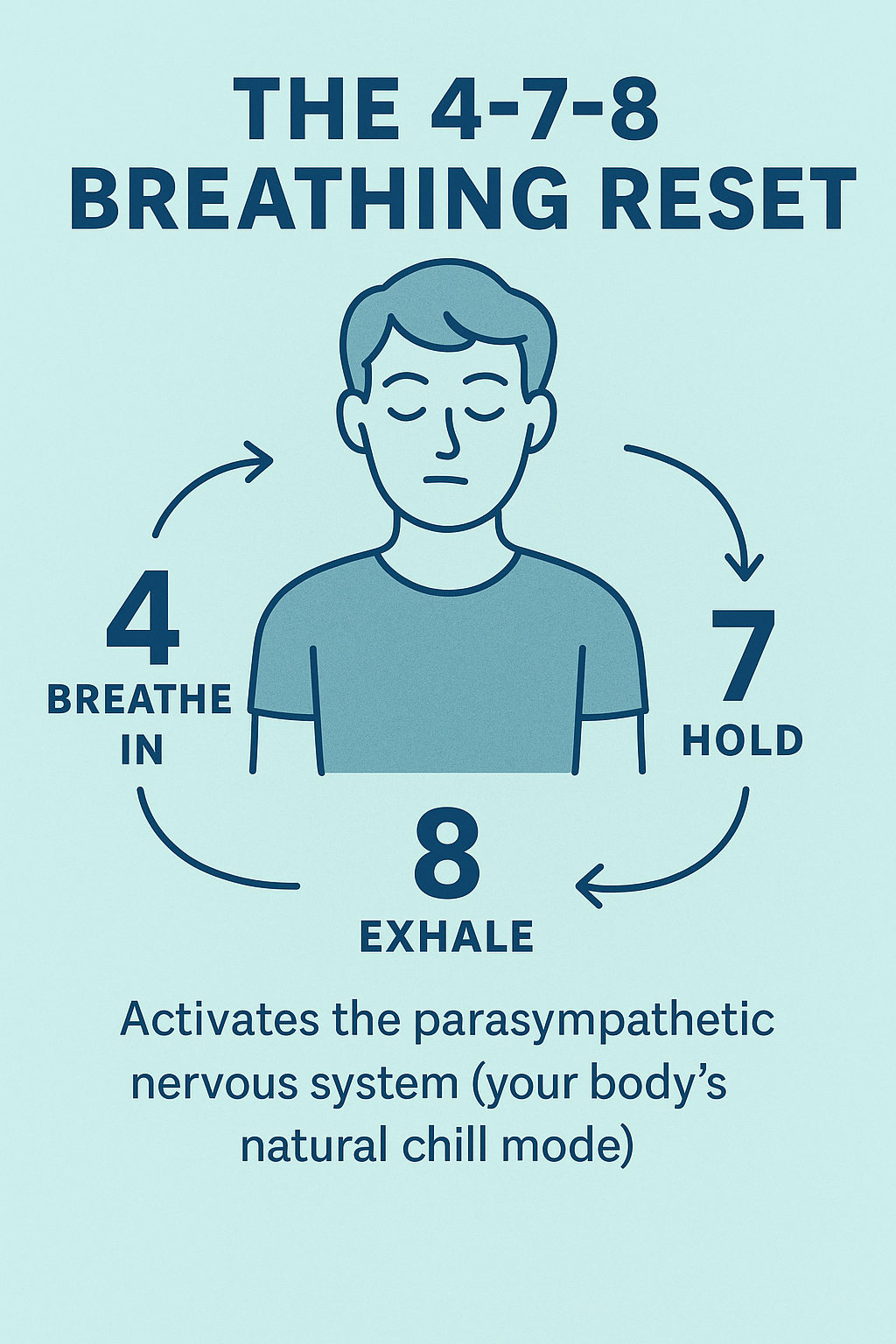
The 4-7-8 Breathing Reset: When you feel that familiar chest tightness or racing heart, your amygdala has flooded your system with stress hormones. Counter this by breathing in for 4 counts, holding for 7, and exhaling for 8. This activates your parasympathetic nervous system—your body’s built-in chill mode.
Name It to Tame It: Simply acknowledging what’s happening can reduce the intensity. Try: “I notice my amygdala is treating this email like a tiger. Interesting.” This engages your prefrontal cortex and creates distance from the fear response.
The 5-4-3-2-1 Grounding Technique: When anxiety spirals, ground yourself by naming:
- 5 things you can see
- 4 things you can touch
- 3 things you can hear
- 2 things you can smell
- 1 thing you can taste
This pulls you out of future catastrophizing and into present-moment awareness.
When Your Cortex Writes Disaster Scripts
The “So What, Now What?” Method: When you catch yourself catastrophizing, ask two questions:
- So what if this worst-case scenario actually happened?
- Now what would I actually do about it?
Often, you’ll realize either the outcome isn’t as catastrophic as your brain suggests, or you have more resources to handle it than fear acknowledges.
Replace the Channel: Your brain can only focus on one stream of thought at a time. When you notice disaster-script thinking, actively replace it with something engaging: a favorite memory, planning your next meal, or mentally decorating your dream house. Don’t fight the anxious thought—just change the channel.
Schedule Worry Time: Set aside 15 minutes daily for designated worrying. When anxious thoughts arise outside this window, tell them: “Thanks, brain. I’ll think about this during worry time.” This contains the anxiety instead of letting it leak into your entire day.

For Social Fear Spirals
The Spotlight Illusion Reality Check: Remember that most people are too busy worrying about their own performance to scrutinize yours. That awkward thing you said? They probably forgot it within minutes because they’re focused on their own concerns.
Exposure with Self-Compassion: Gradually expose yourself to feared social situations, but with kindness. Start small—maybe speaking up once in a meeting—and acknowledge your courage rather than criticizing your nervousness.
Physical Symptoms SOS: When you feel the telltale signs of social anxiety (sweating, blushing, shaky voice), remember that these symptoms are temporary and usually less noticeable to others than you think. Practice progressive muscle relaxation: tense and release different muscle groups to reduce physical tension.
The Daily Maintenance

Exercise Your Fear Away: Regular aerobic exercise literally changes your amygdala’s chemistry, making it less reactive. A 20-minute walk can burn off stress hormones and reset your nervous system.
Sleep Like Your Sanity Depends on It: Because it does. Sleep deprivation makes your amygdala hyperactive and your prefrontal cortex sluggish. Aim for 7-9 hours and create a consistent bedtime routine.
Practice Cognitive Defusion: Instead of “I’m going to fail this presentation,” try “I’m having the thought that I might fail this presentation.” This small shift creates psychological distance from anxious thoughts.
The Reframe That Changes Everything
Fear had to be our first emotion. In a world where hesitation could mean death, those who felt fear first and thought later were the ones who survived long enough to become our ancestors. We carry their vigilant genes, their hyperactive alarm systems, their tendency to assume the worst.
But here’s the plot twist: that same sensitive fear system that protected your ancestors can become your ally in modern life. It’s not your enemy—it’s an overprotective friend who needs better information about what actually constitutes danger.
The rustling in the bushes might just be the wind. But sometimes, it really is a tiger. Fear’s job is to make sure you’re ready for both. Your job is to help it tell the difference.
Next time your ancient alarm system goes haywire, try one of these techniques. Remember: you’re not trying to eliminate fear—you’re learning to be a better translator for an ancient language your brain still speaks.
Want to Deep Dive? Additional Resources
Books That Unpack the Science:
- “Why Zebras Don’t Get Ulcers” by Robert Sapolsky – The definitive guide to stress, anxiety, and how our bodies respond to modern life
- “The Gift of Fear” by Gavin de Becker – Understanding when to trust your fear and when to question it
- “Rewire Your Anxious Brain” by Catherine Pittman – Practical neuroscience for managing anxiety
Apps for Your Toolkit:
- Headspace or Calm – Guided meditations specifically for anxiety and fear responses
- DARE – An app built around exposure therapy and anxiety management
- Insight Timer – Free meditation app with anxiety-specific content
Therapeutic Approaches Worth Exploring:
- Cognitive Behavioral Therapy (CBT) – The gold standard for anxiety disorders
- Acceptance and Commitment Therapy (ACT) – Learning to live with anxiety rather than eliminate it
- Somatic Experiencing – Working with the body’s fear responses directly
Online Resources:
- Psychology Today’s Anxiety Section – Evidence-based articles and therapist finder
- The Anxiety and Depression Foundation of America – Free resources and self-assessment tools
- TED Talks on Fear and Anxiety – Search for talks by Lisa Feldman Barrett, Amy Cuddy, or Tim Ferriss
If You Need Professional Support: Remember, there’s no shame in seeking help. If fear and anxiety are significantly impacting your daily life, relationships, or work, a mental health professional can provide personalized strategies and, if needed, discuss medication options that can make therapy more effective.
What’s one everyday situation where your brain hits the panic button… even though there’s no real threat? Share in the comments—chances are, you’re not alone in having an overprotective ancient alarm system.
Coming Next in The Human Code Series: Part 9: Born to Belong: Why We Need Validation to Survive
How our brains are wired to fear exclusion and seek approval—even from strangers.
We’ve explored how fear became our first emotion, but there’s another ancient survival mechanism that’s even more powerful in modern life: our desperate need to belong. Why do we crave likes on social media? Why does being left out of group chats feel like emotional torture? Why do we sometimes change our entire personality just to fit in?
Next, we’ll dive into the neuroscience of belonging and discover how our tribal wiring makes us seek validation from people we’ve never met, fear exclusion more than physical pain, and build our entire identity around whether others accept us. Spoiler alert: your people-pleasing isn’t a character flaw—it’s an ancient survival strategy that’s gone haywire in the digital age.