
The Psychology of Social Comparison and How to Break Free from the Comparison Trap
Why do we compare ourselves to others—and why does it hurt so much? Discover the psychology behind envy, the comparison trap, and how to transform this ancient instinct into a tool for personal growth.
You scroll through Instagram and there it is again—another promotion announcement, another perfect vacation photo, another life that looks impossibly polished compared to your Tuesday morning reality. Your chest tightens. Your mood drops. And before you can catch yourself, you’re spiraling down a familiar rabbit hole of “Why not me?”

If this spiral sounds familiar, it’s not just dopamine messing with you—our reward systems are literally wired to crave validation and compare our wins to others’. You’re not broken. You’re not shallow. You’re magnificently, problematically human. Because here’s what nobody talks about: we didn’t choose to be this way. We were born to compare.
The Ancient Algorithm Running Your Mind
Somewhere deep in your neural wiring lies an ancient program that hasn’t received an update in thousands of years. It’s constantly scanning, measuring, calculating your position in the invisible hierarchy that surrounds you. This isn’t a bug—it’s a feature. Your ancestors who were best at reading social cues, assessing threats, and positioning themselves advantageously were the ones who survived long enough to pass down their genes.

But here’s the cruel irony: the same mental software that once helped humans navigate tribal dynamics and secure resources is now running wild in a world it was never designed for. Your brain doesn’t know the difference between a genuine threat to your survival and someone’s LinkedIn humble-brag about their “blessed to announce” moment.
The comparison instinct that once kept us alive is now slowly killing our peace of mind.
When Envy Wears Two Faces
Not all envy is created equal. There’s a version that whispers “I want what they have” and quietly motivates you to level up. Psychologists call this “benign envy“—it’s the spark that makes you sign up for that course, start that side project, or finally book that trip you’ve been dreaming about.
But then there’s its shadow twin: malicious envy. This one doesn’t just want what others have—it wants others to lose what they have. It’s the voice that hopes your successful colleague gets fired, that secretly celebrates when someone’s perfect relationship implodes, that finds satisfaction in others’ failures.
The difference between these two isn’t moral superiority. It’s often just circumstance, confidence, and whether you believe you have any real control over closing the gap between where you are and where they seem to be.
The Cultural Programming Running Beneath It All
But the comparison trap isn’t just about evolution and social media—it’s also about the invisible cultural software running in the background of your mind.
Your cultural background acts like a lens, determining not just what you compare, but how intensely those comparisons hit. If you grew up in what researchers call a “tight” culture—one with strong social norms and low tolerance for deviation—you’re likely programmed to compare more frequently and more intensely. These cultures use language that constantly reminds you of collective expectations: “People like us always…” or “You should never…” Your brain learns to monitor others’ behavior as a survival mechanism for fitting in.
Contrast this with “loose” cultures that celebrate individual differences and personal paths. Here, comparison still happens, but it’s less about conformity and more about personal achievement or inspiration.
The very language you speak embeds comparison into your daily thoughts. Notice how often we use reference groups in everyday speech: “successful people,” “people our age,” “others in our field.” These phrases don’t just describe—they invite measurement. When you say “people like me,” you’re unconsciously creating a comparison benchmark.
Even your cultural definition of success shapes your envy triggers. Individualistic cultures might make you envious of someone’s personal achievements, while collectivistic cultures might make you envious of someone’s family harmony or community standing. The trap remains the same, but the triggers are culturally programmed.
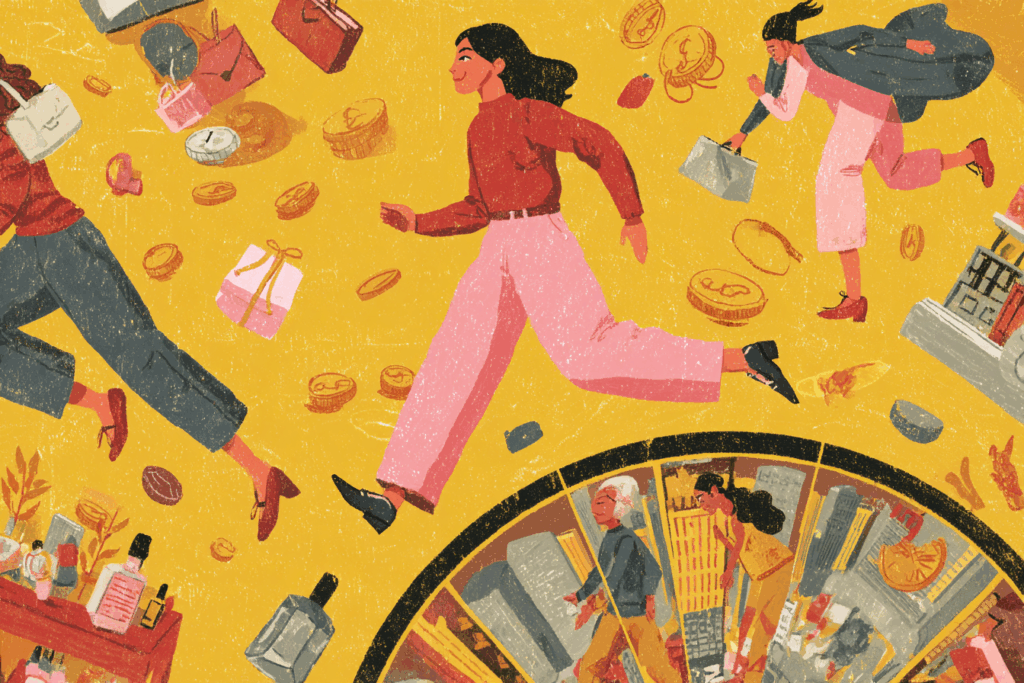
The Digital Amplification Machine
If comparison was already hardwired into us, social media didn’t create the problem—it just gave it steroids and a global stage.
Think about it: never in human history have we had such constant, curated access to everyone else’s highlight reel. Your great-grandmother might have compared herself to a few neighbors or relatives. You’re comparing yourself to everyone who’s ever held a phone and decided to share their best moment.
But here’s what makes it particularly insidious: these platforms are designed to hack your comparison instincts. The “likes” signal social status. The algorithms serve you content that triggers emotional reactions. The editing tools allow people to craft impossibly perfect versions of reality. You’re not just seeing lives—you’re seeing lives optimized for envy.

Social media platforms have essentially become “exceptionally fertile ground for the experience of envy,” creating what researchers call a “notable positive self-representation bias.” Everyone looks more successful, more attractive, more fulfilled than they actually are. Including you, when you post.
The Comparison Trap: How We Get Stuck
The social comparison trap isn’t just about feeling bad when you see someone else’s success. It’s a self-reinforcing cycle that becomes harder to escape the longer you’re in it.
Here’s how it works: You compare yourself to someone who seems better off. You feel inadequate. That inadequacy makes you more sensitive to future comparisons. You start obsessively checking others’ profiles, seeking external validation, ruminating on what you lack. Your self-esteem drops, making you even more vulnerable to the next comparison. The trap tightens.

It’s particularly vicious because comparison becomes automatic. Your brain starts doing it without your permission, constantly scanning for who has more, who’s doing better, who seems happier. The comparison mind never rests.
The Modern Casualties
The research is sobering. Constant upward social comparison—measuring yourself against those who seem better off—is strongly linked to chronic feelings of inferiority, anxiety, depression, and low self-esteem. It creates what psychologists call “self-discrepancy“—a gap between who you are and who you think you should be based on what you see in others.
The casualties aren’t just individual. In societies where comparison runs unchecked, research suggests we can literally split into classes based on envy and competition alone—not birth, not education, just the relentless drive to either keep up or give up.
We’re witnessing the birth of new psychological phenomena: “Facebook depression,” FOMO (fear of missing out), and what some call “compare despair”—the chronic exhaustion that comes from never measuring up to an impossible standard.

The Evolutionary Wisdom Hidden in Modern Pain
But here’s what’s fascinating: understanding why we compare can be the first step to freedom from the trap.
When you realize that the urge to measure yourself against others isn’t a personal failing but an evolutionary inheritance, something shifts. You can start to see the feeling without being consumed by it. You can recognize the ancient alarm bell without having to respond to every ring.
The comparison instinct was never meant to make you happy—it was meant to keep you alive and motivated to improve your position. In a world of genuine scarcity, it served us well. In a world of artificial abundance and curated perfection, it needs conscious management.

Breaking Free: From Trap to Tool
The goal isn’t to stop comparing entirely—that’s neither possible nor necessarily desirable. The goal is to become aware of when it’s happening and redirect it toward growth rather than self-destruction.
🔄 Redirect the Comparison Instinct
Instead of: “Why don’t I have what they have?”
Try: “What can I learn from their path?”Instead of: “They’re ahead of me.”
Try: “I’m not there yet.”Instead of: “I’m not good enough.”
Try: “I’m growing at my own pace.”

🧠 Catch Your Cultural Programming
Instead of: “People like me should have this figured out by now.”
Try: “I’m on my own timeline.”Instead of: “Everyone in my field is more successful.”
Try: “Success looks different for everyone.”Instead of: “I’m falling behind my peers.”
Try: “I’m exactly where I need to be for my journey.”

📱 Curate Your Digital Environment
Unfollow accounts that consistently trigger comparison spirals
Even if they’re friends—you can mute rather than unfollow to avoid dramaFollow accounts that inspire growth, not envy
Look for people sharing struggles, failures, and realistic behind-the-scenes contentSet phone boundaries around comparison triggers
No social media first thing in the morning or right before bed when you’re most vulnerable
💪 Build Psychological Availability
Remind yourself of your resources: skills, support system, past wins
When you feel capable of change, benign envy (motivation) increases while malicious envy (resentment) decreasesPractice the “yet” mindset:
“I don’t have that… yet.” “I’m not there… yet.” “I haven’t figured it out… yet.”Focus on your sphere of influence:
What can you actually control today to move toward what you want?

🎯 Channel Comparison Into Action
Use the “Admiration Audit”:
When you feel envy, ask: “What specifically am I admiring? How can I cultivate that quality in my own way?”Practice temporal comparison:
Instead of comparing yourself to others, compare present you to past youCreate “inspiration files” not comparison triggers:
Save posts that motivate action, not ones that make you feel inadequate
Instead of consuming others’ highlight reels passively, ask yourself what you’re really seeking and whether this particular form of inspiration is serving you.
The Ancient Software, Modern Wisdom
We are born to compare. But we’re also born with the capacity to step back, observe our own minds, and choose how to respond to our inherited impulses. The comparison instinct will always be with us—it’s too fundamental to our social nature to disappear.
The question isn’t whether you’ll compare yourself to others. The question is whether you’ll let that comparison trap you in cycles of inadequacy and envy, or whether you’ll use it as information, inspiration, and fuel for your own authentic growth.
Your ancestors used comparison to survive in a dangerous world. You can use that same impulse to thrive in a complex one—but only if you understand what you’re working with and learn to be the conscious director of your ancient mind.
The next time you feel that familiar pang of “everyone else has it figured out,” remember: you’re not experiencing a personal failing. You’re experiencing ten thousand years of human evolution doing exactly what it was designed to do.
The difference is, now you know.

Reflection Prompt: Where in your life does comparison energize you—and where does it deplete you?
Further Reading & Resources
📚 Books to Dive Deeper
- Social: Why Our Brains Are Wired to Connect by Matthew D. Lieberman
- The Righteous Mind: Why Good People Are Divided by Politics and Religion by Jonathan Haidt (explores cultural programming)
- Mindset: The New Psychology of Success by Carol S. Dweck (growth vs. fixed mindset)
- The Culture Code: The Secrets of Highly Successful Groups by Daniel Coyle
🔬 Key Research to Explore
- Leon Festinger’s original Social Comparison Theory (1954)
- Studies on “benign vs. malicious envy” in organizational psychology
- Research on cultural dimensions (Hofstede’s “tight vs. loose cultures”)
- Social media and mental health meta-analyses
🛠️ Practical Tools
- Apps: Moment or Screen Time (track social media usage)
- Journaling prompts: Daily gratitude + personal progress tracking
- Mindfulness: Headspace or Calm apps for awareness practices
- Digital detox: Try a 24-48 hour social media break and notice the difference
🎧 Podcasts & Further Learning
- The Science of Happiness (Berkeley’s Greater Good Science Center)
- Hidden Brain episodes on social psychology
- The Ezra Klein Show interviews with social psychologists
Coming Next in The Human Code Series:
Part 8: The Emotion Code – Why we evolved to feel “irrational” emotions like shame, jealousy, and embarrassment. We’ll explore emotional survival: what helped us stay alive back then… but causes inner chaos today.